12 tips for writing SEO-optimized content in 2026 After the New SEO Update
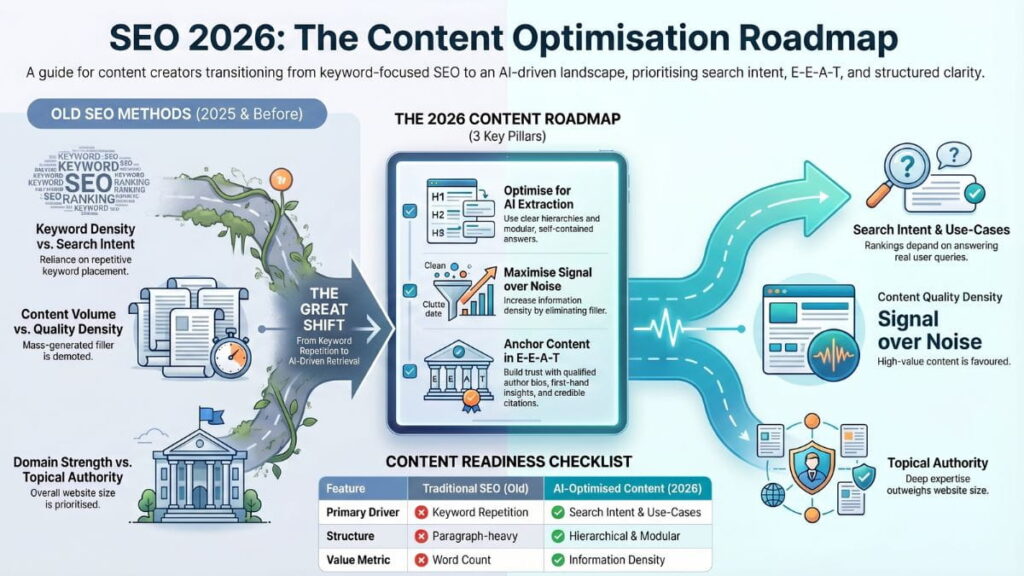
Search rankings in 2026 depend less on keyword placement and more on how effectively content answers real user queries. Following the March Core Update 2026, Google has shifted toward AI-driven retrieval systems that prioritize structured, directly usable content for summaries and AI-generated responses.
The update significantly strengthens the role of E-E-A-T (Experience, Expertise, Authoritativeness, Trustworthiness). Content backed by real expertise and first-hand insight is rewarded, while thin, generic, or low-value pages are increasingly demoted.
As a result, content that is clear, well-structured, and genuinely useful is outperforming keyword-heavy or filler-based writing.
What Changed After the New SEO Update
The latest core updates have introduced a few major shifts:
AI Overviews now extract and present answers directly, making it critical for content to be structured, reliable, and source-worthy.
Ranking systems focus on clarity, structure, and usefulness rather than keyword repetition.
Copy-paste and mass-generated content without original insight is less likely to rank. Humanized, value-driven content performs better.
Deep expertise within a subject area is now more important than overall domain strength.
Content needs to be readable, well-structured, and easily extractable for AI-generated summaries.
This means SEO optimized content must be designed for both users and AI systems that summarize information.
12 Practical Tips to Optimize Content in 2026
Define a Clear Information Objective Start with a precise query, problem, or use-case. Content should be mapped to a specific search intent, not a vague topic.
Structure Content Around Search Intent, Not Keywords Organize sections based on query clusters and intent (informational, comparative, transactional). Keyword usage should support semantics, not drive the structure.
Audit and Consolidate Low-Value Content Identify thin, duplicated, or low-performing pages. Merge, expand, or remove them. Strong sites are built on content quality density, not volume.
Strengthen Content Architecture and Hierarchy Use clear heading structures (H1–H3), logical sequencing, and internal linking. This improves crawlability, comprehension, and AI extractability.
Optimize for Featured Snippets and AI Extraction Write concise, self-contained answers under relevant headings. Use definition-style responses, bullet points, and structured formats that can be directly surfaced.
Increase Information Density (Eliminate Filler) Each paragraph should add new information. Avoid repetition, generic statements, and padding. Focus on signal over noise.
Deepen High-Value and Core Topic Pages Enhance important pages with:
Use-case examples
Updated statistics
Expert commentary
Visual aids (charts, diagrams)
Depth should improve understanding, not just length.
Build Topical Authority Through Coverage and Linking Cover related subtopics comprehensively and interlink them logically. This reinforces subject-matter expertise at the topic level.
Demonstrate E-E-A-T Signals For sensitive or YMYL topics:
Use qualified authors
Add author bios with credentials
Reference credible external sources
Trust and expertise are now directly tied to ranking potential.
Maintain Semantic Clarity and Precision Use clear, unambiguous language. Align terminology with how users search and how systems interpret meaning. Avoid unnecessary jargon unless contextually required.
Keep Content Fresh and Factually Updated Update outdated information with new data, examples, and references. Changing timestamps without improving content quality has no impact.
Optimize for Retrieval and Reusability Write content that is easy to extract, summarize, and cite:
Use modular sections
Provide direct answers
Maintain clean formatting
Content should work well in both traditional rankings and AI-generated outputs.
What Type of Content Performs Best After the Latest Updates?
Content that performs well in 2026 typically has:
Direct answers to specific questions
Clear structure with logical flow
Real insights instead of generic statements
Concise explanations supported by examples
High readability and scannability
Long content still works, but only when it maintains clarity throughout.
Protecting Rankings in a Rapidly Changing SEO Environment
Frequent updates are now part of the ecosystem. Instead of reacting to each change, focus on fundamentals:
Write useful, accurate content
Maintain clean structure
Keep content updated
Avoid manipulative SEO practices
Websites that follow these principles tend to remain stable even after algorithm changes.
FAQs
What are the major SEO updates in 2026 and how do they impact website rankings?
The major updates focus on AI-driven search results, including AI Overviews that summarize content directly on search pages. Rankings now depend more on clarity, structure, usefulness, and E-E-A-T (Experience, Expertise, Authoritativeness, Trustworthiness) rather than keyword density. Content that demonstrates credibility and answers queries clearly is more likely to be surfaced.
How do Google AI Overviews and AI search results affect traditional SEO traffic?
AI Overviews reduce clicks by showing direct answers. Websites now need to focus on being selected as a source rather than just ranking.
What type of content performs best after the latest Google SEO updates?
Content that is well-structured, concise, and directly answers user intent performs best. Articles with strong headings, clear explanations, logical flow, and in-depth coverage of topics are more likely to rank and be used in AI-generated results.
How can you optimize blog content to rank in AI-generated search answers?
Use clear headings, answer questions directly, keep paragraphs focused, and structure content so it can be easily extracted.
How can websites protect their rankings during frequent Google algorithm changes?
Websites should focus on maintaining content quality, updating information regularly, and ensuring strong structure. Avoid relying on outdated tactics like keyword stuffing and instead prioritize clarity and user value.