
| TL;DR: In 2026, Google’s scrutiny of “Your Money or Your Life” (YMYL) content is at an all-time high. To rank, financial firms must move beyond keyword density to a strategy of E-E-A-T verification, Topic Clusters, and Third-Party Validation. This guide provides an execution-layer framework for capturing search intent in the high-stakes financial sector. |
Google classifies financial advice as YMYL Content (Your Money or Your Life) because inaccurate information in this sector can cause irreversible harm to a user’s financial stability. Whether it’s a mortgage calculator, an investment guide, or a tax-saving strategy, the search engine treats these pages with a “guilty until proven authoritative” filter.
In the financial sector, search engines look for consensus. If your advice contradicts established professional standards without a clear, expert-led reason, your rankings will suffer. The goal of the algorithm is to act as a safety net, ensuring that only the most reliable, verified entities reach the top of the search engine results pages (SERPs). For a founder or marketing head, this means your SEO Strategies cannot afford to be “average.”
For financial websites, Google isn’t just looking at the keywords on a page; it is evaluating the entity behind the content. The E-E-A-T framework—Experience, Expertise, Authoritativeness, and Trustworthiness—is the yardstick for this evaluation.
| E-E-A-T Pillar | Expert-Voice Implementation Strategy |
| Experience | Content must reflect “lived experience.” Use case studies and internal data to prove you aren’t just summarizing other blogs. |
| Expertise | Articles must be authored or reviewed by certified professionals (CFAs, CPAs, etc.) with visible credentials and links to official registries. |
| Authoritativeness | This is a measure of your reputation. It is built by earning mentions in high-authority financial journals and professional hubs. |
| Trustworthiness | The anchor of the framework. Verified by Technical SEO (HTTPS), transparent fee disclosures, and clear “About Us” pages. |
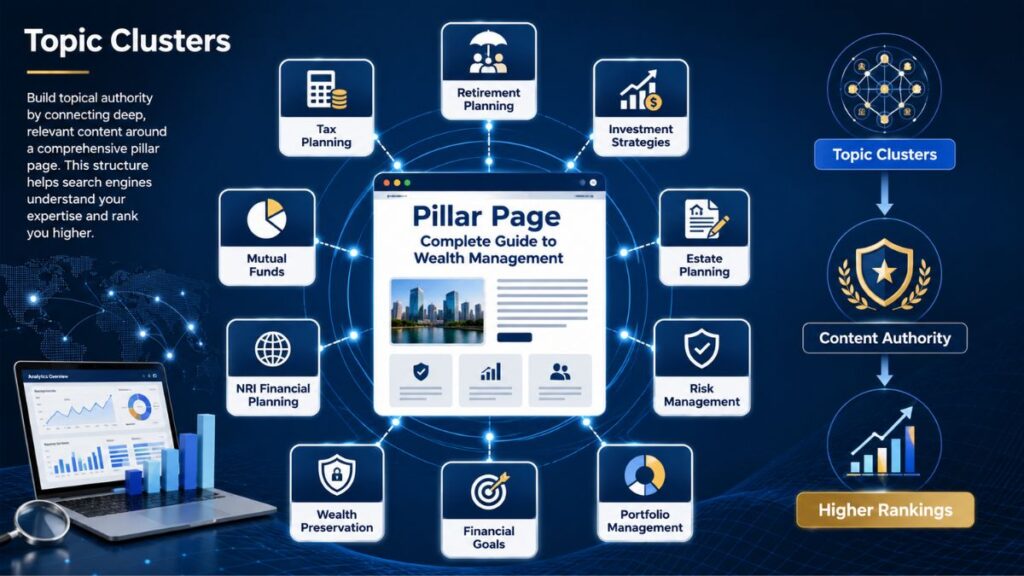
To win at SEO for financial services, you must stop thinking in isolated keywords and start thinking in Topic Clusters. Google prefers to rank websites that demonstrate a comprehensive understanding of a niche rather than those that only cover a single popular term.
Your Pillar Page should be a “Skyscraper” piece—a 3,000+ word resource that answers every primary question about a broad topic (e.g., “The Complete Guide to Wealth Management in India”). This page acts as the central hub for your authority.
Support the pillar with 15–20 sub-articles (clusters) targeting long-tail queries. For example, if your pillar is about retirement, your clusters might include:
In YMYL SEO, what you say about yourself is less important than what others say about you. To satisfy Google’s Trust pillar, you must provide clear Third-party validation.
Your website must prominently feature your Industry certifications. Whether it is SEBI registration in India, SEC compliance in the US, or specialized certifications like CFA or CFP, these badges act as a technical trust signal. Google’s crawlers look for these entities to verify that the business is legally permitted to give financial advice.
While generic reviews are helpful, Client testimonials in the financial sector should focus on reliability and results. When including these, ensure they are linked to verified platforms (like Google Business Profiles or Trustpilot) to provide the transparency Google requires for high-risk content.
Content alone isn’t enough to rank for high-KD financial terms. You need a robust Off-page SEO strategy that focuses on high-quality backlink acquisition.
Google views a link from a reputable source like Bloomberg, The Economic Times, or Forbes as a massive vote of confidence. This Third-party validation is often the deciding factor between two pieces of equally well-written content. For financial brands, Off-page SEO should not be about “volume” but about “relevance” to the core financial industry.
Technical health is a primary trust signal for YMYL sites. A site that is slow, insecure, or poorly formatted signals a lack of professional oversight.
[ ] Security (HTTPS): Ensure flawless encryption. Any “Not Secure” warning is an instant demotion.
[ ] Author Schema: Use JSON-LD schema to link your experts’ names to their professional credentials.
[ ] Precision in Every Pixel: Monitor character counts in meta descriptions. A truncated Call to Action (CTA) in financial services looks unprofessional.
[ ] Word Count Optimization: Ensure your content has enough depth to satisfy the intent without unnecessary fluff.
[ ] Case Consistency: Use a case converter to ensure headings and titles are professional and consistent.
Mastering the nuances of financial SEO requires more than just good writing; it requires a business-first architecture. At Ooptiq, we bridge the gap between engineering and growth by creating authoritative, citable content that fits perfectly within the modern search ecosystem.
In an AI-first market, “shallow coverage” is a liability. We help you move beyond generic blogs to build Content Authority that search engines trust. Whether you are looking to audit your current strategy or build a new topic cluster from the ground up, we focus on the execution layer of your marketing funnel.
Take Action: Don’t let your expert insights get buried under generic AI noise. Book a Content Strategy Audit with Ooptiq and start building a digital presence that actually converts.
Winning at SEO in the financial sector is a marathon of trust. By focusing on YMYL standards, building deep Topic Clusters, and leveraging Third-party validation, you position your brand as a reliable authority. From showcasing your Industry certifications to curating verified Client testimonials, every element of your site must reflect “Trustworthiness.” When you combine this with a disciplined Off-page SEO strategy, you ensure that your brand isn’t just another voice in the crowd—it’s the voice that leads the conversation.
YMYL stands for “Your Money or Your Life.” Google treats it differently because inaccurate information in this category can lead to significant financial harm. Consequently, Google applies a much higher threshold for quality, accuracy, and truth for these queries compared to non-YMYL topics.
Financial content is high-risk because it involves life-altering monetary and legal consequences. Because markets and regulations change rapidly, Google prioritizes content that is regularly updated and verified by proven experts to prevent users from following outdated or dangerous advice.
Google evaluates trust through the E-E-A-T signal, looking for verified author credentials, secure technical infrastructure (HTTPS), and external validation. This includes Third-party validation from reputable sites and clear evidence of Industry certifications.
E-E-A-T stands for Experience, Expertise, Authoritativeness, and Trustworthiness. It is the core framework Google uses to ensure that high-stakes financial queries are answered by qualified professionals, protecting users from low-quality or predatory content.
Financial websites can improve rankings by securing their site technically, using Topic Clusters to prove deep expertise, and ensuring every piece of content is reviewed by a certified professional. High-quality Off-page SEO and displaying Client testimonials further amplify these trust signals.